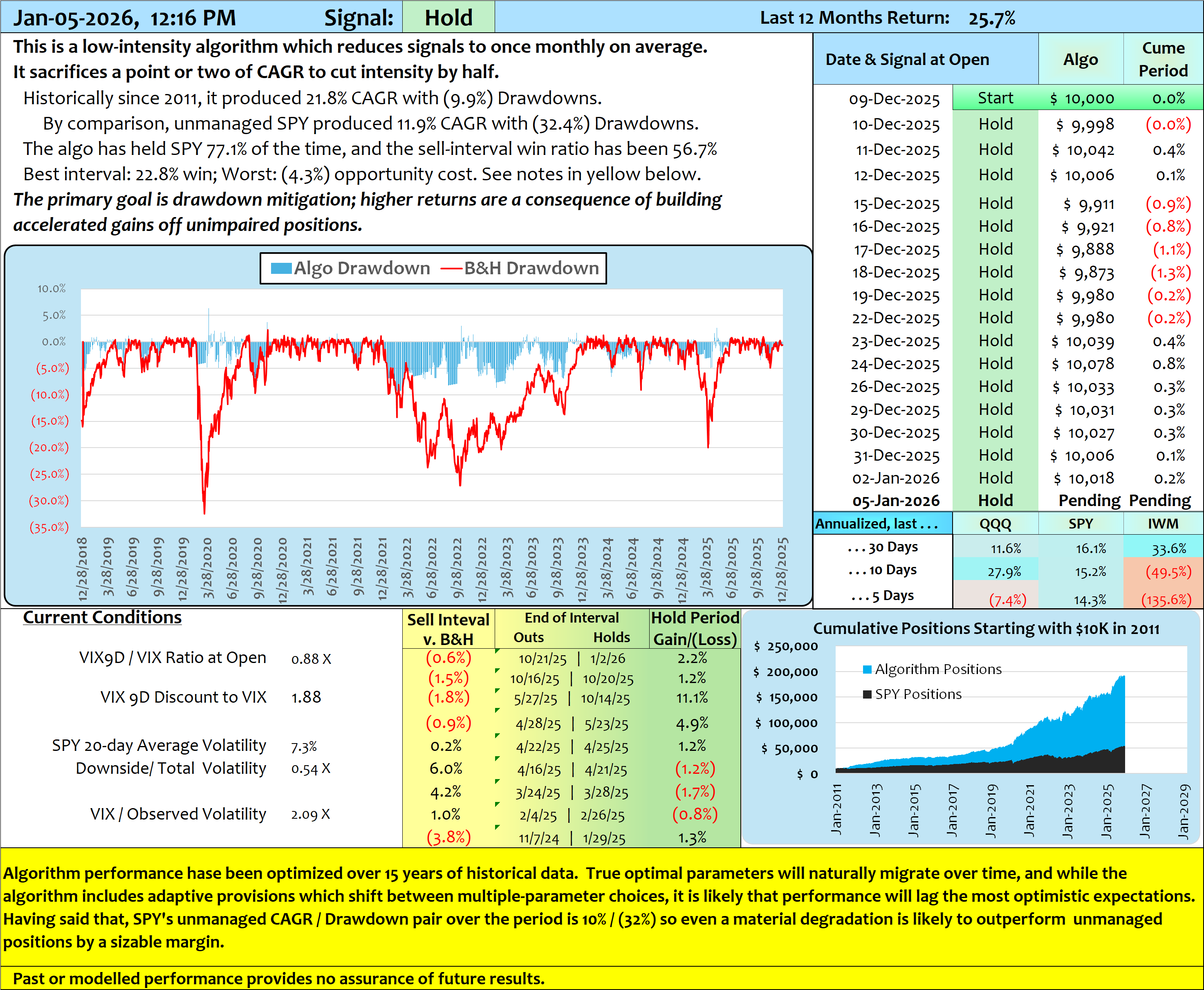
The Risk Signature Algorithm consists of three competing modules deploying different market views. Those views range from aggressive to risk-averse and each module produces a risk assessment using a unique methodology. Typical factors include the discount of VIX9D to the VIX, their ratio, the associated next-day gain or loss for the two VIX-related conditions, and SPY trends and observed volatility.
The Risk Signature Algorithm produces low-frequency signals, about one per month, an improvement on the more frequent ‘noise’ of the 2019 legacy models. As modelled, the worst drawdown since 2011 indicated (9.9%) compared to (32%) for unmanaged SPY. By avoiding the worst downturns, the algorithm was able to produce 22% compound annual growth since 2011 and 27% in 2025.
If You Want a Deeper Understanding
Take a moment to understand why the 9-day VIX (VIX9D) compared to the 30-day VIX (VIX) is indicative of emerging risk. The two indices reflect 9-day and approximately 30-day implied volatilities of S&P options respectively. It’s almost always true that risk is more dramatically manifest in near-term stress whereas longer-term perceptions gravitate toward normalcy. The concept is quantifiable in diversified financial instruments. Market volatility might cause gyrations in near-term gains and losses, but long-term returns gravitate toward normal averages.
So, under normal circumstances VIX9D trades at a discount to VIX; it is discounted 70% of the time. But if VIX9D jumps above the VIX level it indicates market sentiment reflects emerging risk. Similarly, the ‘Ratio’ of VIX9D/VIX and the associated historical next-day returns provide risk information. Calibrating these effects, along with peripheral indicators like multiple trends and observed volatility, is the function of the Risk Signature Algorithm.
Calibrations can be performed using different methodologies; the Risk Signature Algorithm uses three such modules which compete to govern signals. The composite signal is drawn from the module which is performing best over a recent lookback unique to each module, varying from 8 days to 27 days. Signals (buy, sell, hold, out) are produced based on opening values each morning.
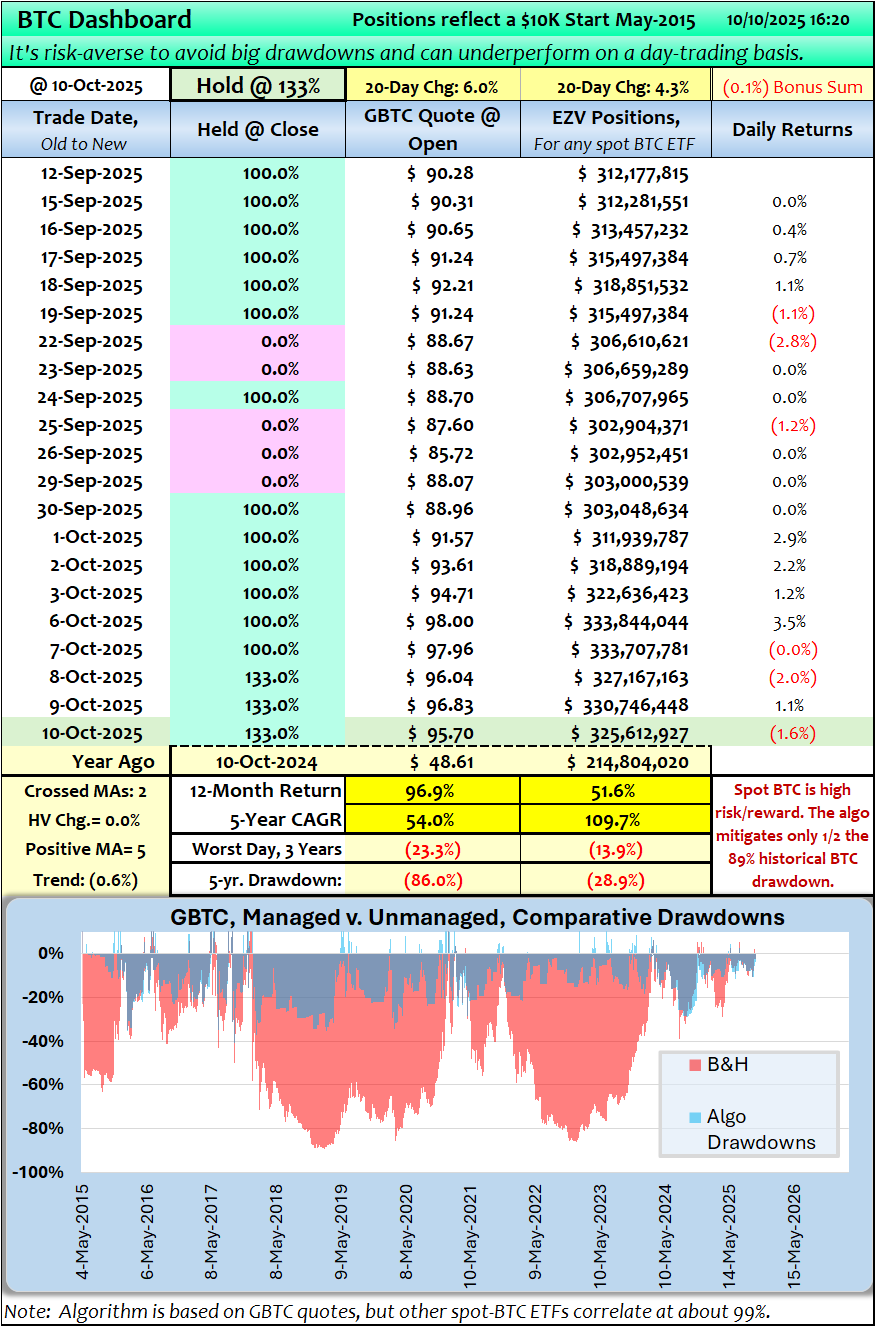
The BTC algorithm uses GBTC price trends, six moving averages (MAs) as well as incidents of crossing MAs. The shortest moving average is a few days and the longest is well over 100 days.
An important discovery was that extended loss periods like 2018 and 2022 caused algorithm performance to falter when long-period MAs used fixed lookbacks. The longer MAs lingered in negative territory and delayed signal rebounds, so the long-period lookbacks were reduced for trailing loss periods. That effect was calibrated using data since 2015.
When the one-day change in observed volatility exceeds an approximate 18% threshold, the likelihood of a next-day loss increases materially. A one-day 18% volatility change is a big deal but not for Bitcoin; there were 65 days over the last 10-plus years when that occurred; that’s a 2.5% incidence. But selling on those days produces aggregate savings of 126%, about 10% annually on average.
Optimized parameters produce 175% annual returns using historical quotes, but I don’t believe that will be replicable in the future. GBTC produced a 69% compound growth rate with no algorithmic enhancement, but that started from $0.42 per share. In 2017 alone, GBTC gained 1,533% from minimal starting valuations.
A more realistic goal would be performance over the last 5 years: 46% returns with drawdowns reduced by two-thirds. But understand that the worst unmanaged drawdown was 86%, so a 28% potential drawdown with the algorithm still makes BTC a high-risk holding, albeit with very high return potential.
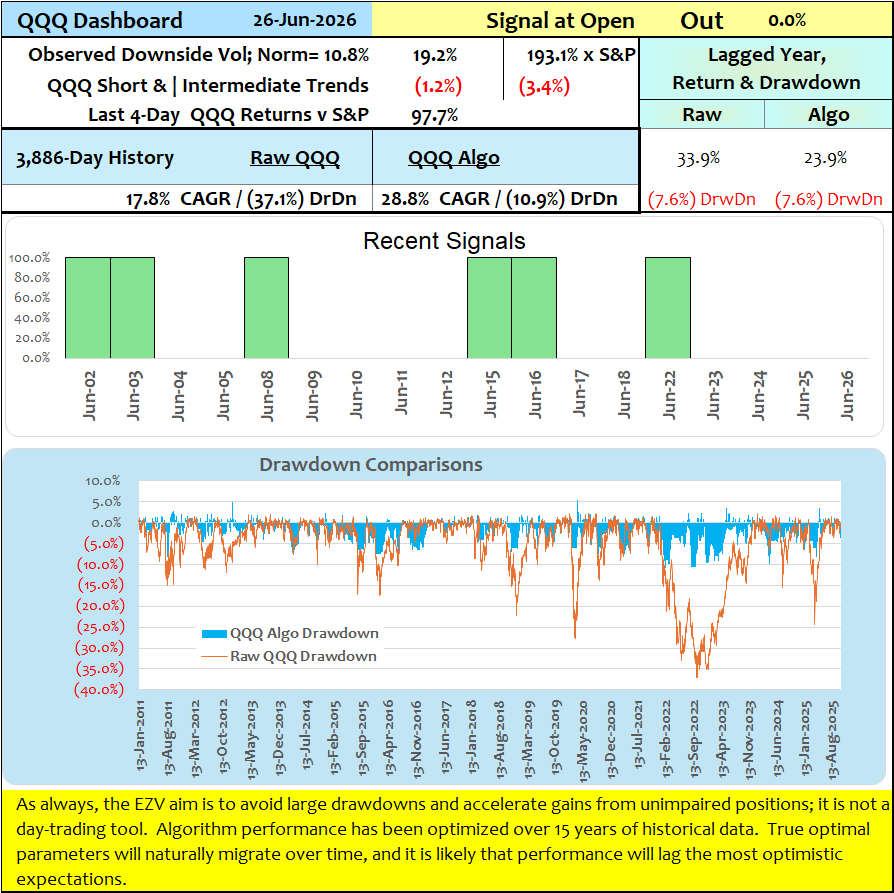
Tech stock momentum is a powerful thing, until it isn’t. For the last 15 years, QQQ returned 17% annually, but at its worst it fell 37%. Over that same period, the QQQ algorithm indicates a worst drawdown of 11% with returns being boosted to 28%. Remember, none of the EZV systems support day-trading; improved returns are accomplished by avoiding large drawdowns and riding accelerated gains from discounted reentry prices.
The QQQ algorithm begins with the signals of the Risk Signature algorithm and then, because the Nasdaq is more volatile, adds a second layer of risk protection by monitoring QQQ-specific trends, divergence from S&P returns, and downside volatility.
The old 60:40 buy-and-hold portfolio philosophy is dead, but most portfolios do hold a mix of risk instruments. In order of risk, that mix might consist of options, stocks/ETFs, high-yield symbols, conventional bonds/ETFs, and cash. Option positions can be managed using the S&P and QQQ algorithms, the same for stocks & ETFs.
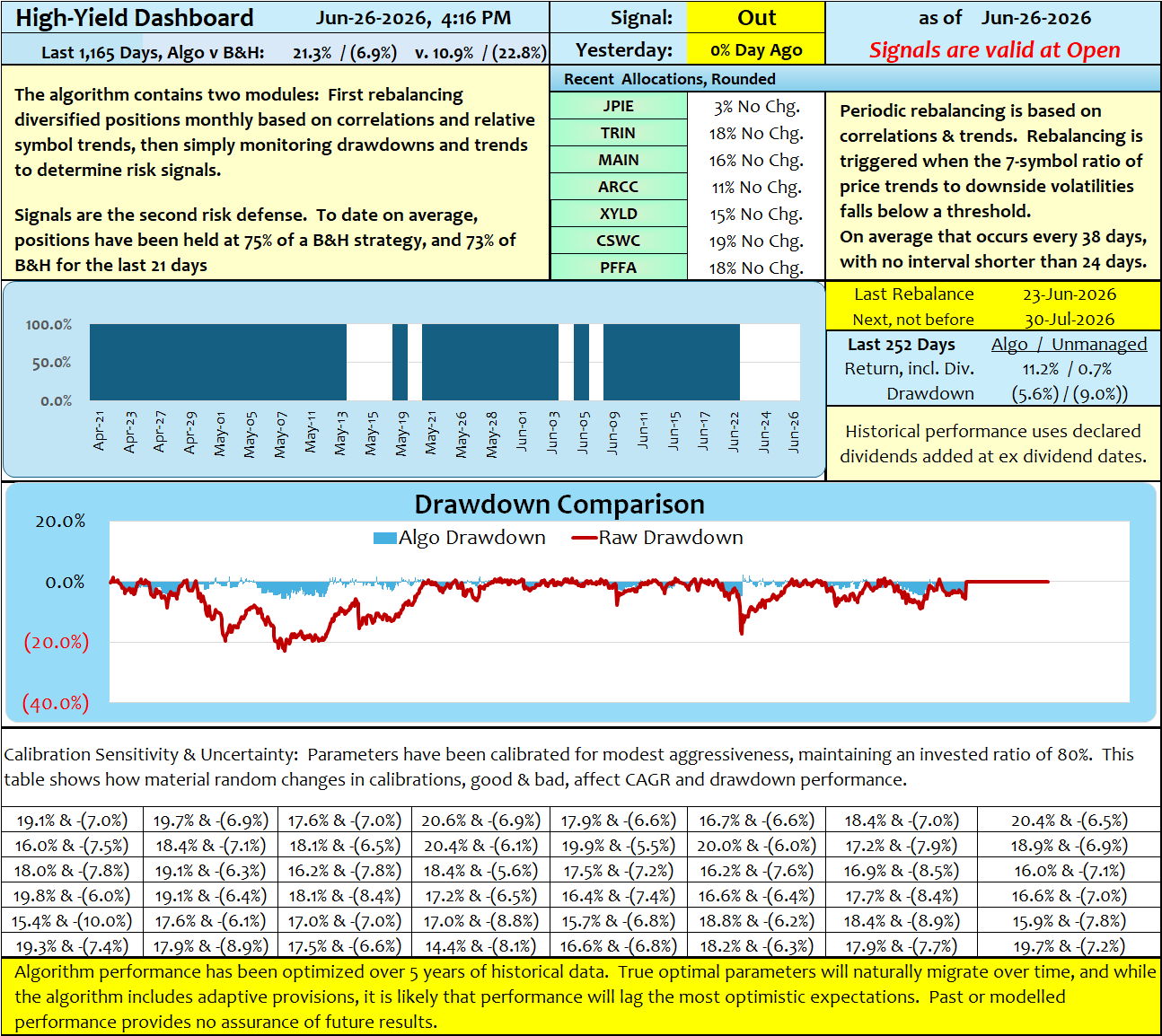
The Hi-Yield algorithm fills a big gap. With bonds offering 4% yields, some 10% yield symbols could be attractive if the drawdown risk is managed effectively. We track a 7-symbol mix of stocks and ETFs that, on average, pay about 10% dividends.
The symbols are:
JPIE is a multisector-bond ETF while TRIN, MAIN, ARCC and CSWC are business development companies; XYLD is an S&P covered-call ETF, and PFFA holds preferred stocks. All are geared toward income, and average dividend yields are about 10%; the four business development holdings add capital gain potential.
The algorithm contains two modules:
The modelled results indicate the combined effect is to reduce drawdowns from (17.9%) for the 7-symbol unmanaged blend to (6.1%) over the last 5 years. If any risk-averse investor had to tolerate a 17.9% loss from any peak to trough, the incorporation of these instruments in the portfolio would be limited.
As with all EZV algorithms, the avoidance of drawdowns boosts returns. By eliminating about two-thirds of the loss exposure, returns from the high yield mix jump from 10.4% to 19.0%.
Curious how our algorithms navigate risk across market cycles?
Download a free package of historical signals through 2025 covering Risk Signature (S&P), BTC, Nasdaq (QQQ), and Hi Yield. Explore the data yourself—no membership required—and see how .